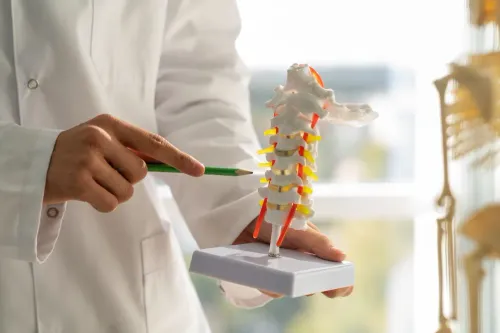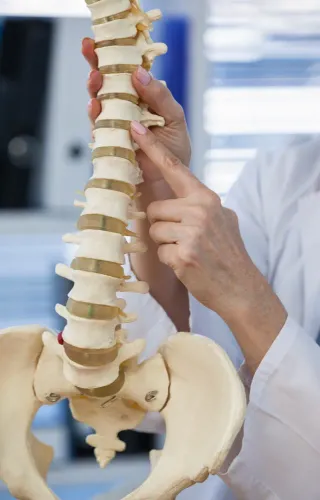
Back pain is extremely common, but not every episode has the same cause. Muscle strain, prolonged sitting, poor lifting technique, age-related changes, disc problems, nerve compression, spinal stenosis, injuries, and several other conditions can produce symptoms involving the back.
Understanding the pattern of symptoms can help patients recognise when a spine evaluation may be useful.
Back Pain Is Only One Possible Symptom
Spine problems do not always remain confined to the neck or back.
Depending on the structures involved, symptoms can include:
- Lower-back pain
- Neck stiffness
- Pain travelling into a leg
- Pain extending into an arm
- Tingling
- Numbness
- Muscle weakness
- Difficulty walking comfortably
- Reduced spinal movement
- Pain aggravated by certain positions
Sciatica, for example, commonly refers to symptoms affecting the sciatic nerve pathway and may produce pain extending from the lower back or buttock into the leg.
A cervical spine problem may sometimes produce symptoms affecting the shoulder, arm, or hand.
Why Self-Diagnosis Can Be Misleading
Patients frequently use terms such as slipped disc, sciatica, cervical problem, or spondylosis to describe almost any persistent spinal discomfort.
These terms are not interchangeable.
Even when an MRI identifies structural changes, the scan must be interpreted alongside symptoms and clinical examination. Some imaging findings can occur without causing significant symptoms, while apparently modest abnormalities can sometimes be clinically important.
This is why treatment should be based on the complete clinical picture rather than an imaging report alone.
Treatment Depends on the Underlying Condition
Many spine conditions can initially be treated without surgery.
Depending on the diagnosis, management may involve:
- Appropriate medication
- Activity modification
- Physiotherapy
- Core strengthening
- Posture improvement
- Ergonomic changes
- Weight management
- Guided rehabilitation
Patients working long hours at desks across Kharghar and Navi Mumbai may also need to examine workstation setup, sitting habits, physical activity, and repetitive movement patterns.
Spine surgery is generally considered according to the specific diagnosis, severity, neurological findings, structural instability, response to conservative treatment, and overall clinical situation.
Warning Signs Deserve Prompt Assessment
Certain symptoms should not simply be managed through home remedies.
Seek prompt medical evaluation for significant weakness, progressive numbness, major trauma, difficulty controlling bladder or bowel function, severe unexplained pain, fever associated with back pain, or rapidly worsening neurological symptoms.
These symptoms do not automatically indicate that surgery is required, but they can warrant timely investigation.
Building a More Accurate Treatment Plan
For people experiencing persistent spinal symptoms in Navi Mumbai, an orthopedic spine evaluation can establish whether the problem is muscular, degenerative, neurological, traumatic, or related to another condition.
Dr. Atul Patil Orthopedic Surgeon evaluates spine-related complaints alongside joint and musculoskeletal conditions in Kharghar. Treatment planning should consider not only scan findings but also pain severity, neurological function, mobility, occupation, age, activity requirements, and response to previous care.
Back pain is a symptom rather than a diagnosis. Identifying its source is what allows treatment to become more focused.
Keywords